NYC Pied-à-Terre Tax Explained: What Luxury Home Buyers Need to Know in 2026

New York City has introduced a new tax that could significantly affect some owners and buyers of high-value residential real estate. Commonly referred to as the NYC Pied-à-Terre Tax, the new Non-Primary Residence Property Surcharge applies to certain residential properties that are not used as a qualifying primary residence.
For buyers considering a second home in Manhattan or elsewhere in New York City—and for current owners of luxury condos, co-ops, and townhouses—the surcharge is an important new carrying cost to understand.
Here is what NYC buyers, sellers, investors, and property owners need to know.
What Is the NYC Pied-à-Terre Tax?
The NYC Pied-à-Terre Tax is an annual property tax surcharge on certain high-value New York City residences that are not used as a qualifying primary residence.
Although widely referred to as the "pied-à-terre tax," the official name is the Non-Primary Residence Property Surcharge.
Unlike the New York City and New York State transfer taxes or New York State mansion tax, which generally arise when a property is purchased or sold, the pied-à-terre surcharge is an ongoing annual ownership expense for properties that qualify.
That distinction is particularly important for buyers evaluating the long-term cost of owning a second home in New York City.
What Does "Pied-à-Terre" Mean?
"Pied-à-terre" is a French expression that literally means "foot on the ground." In real estate, it generally describes a residence that an owner maintains for occasional or part-time use rather than as a primary home.
In New York City, pied-à-terre apartments have long been popular among buyers who live primarily elsewhere but want a residence in Manhattan for work, business, entertainment, family visits, or simply to spend part of the year in the city.
However, for purposes of the new surcharge, simply calling a property a pied-à-terre does not determine whether it is taxable.
Eligibility depends on how the property is used, who occupies it, the property's NYC Department of Finance valuation, and whether an exemption applies.
Which NYC Properties May Be Subject to the Pied-à-Terre Tax?
For the 2026–27 and 2027–28 property tax years, the surcharge may apply to:
One-, two-, and three-family homes:
Properties with a NYC Department of Finance market value of $5 million or more may potentially be subject to the surcharge.
Condominiums and cooperative apartments:
Individual condo and co-op units with a Department of Finance market value—or applicable imputed value—of $1 million or more may potentially be subject to the surcharge.
This distinction is extremely important because the Department of Finance's valuation is not necessarily the same as the property's purchase price or current market value in a real estate transaction.
A Manhattan apartment selling for several million dollars, for example, does not automatically owe the surcharge simply because of its sale price.
Who May Be Exempt From the NYC Pied-à-Terre Tax?
The surcharge is aimed at qualifying non-primary residences, but there are important exemptions.
According to the NYC Department of Finance, a property generally will not be subject to the surcharge when it is used as the primary residence of a qualifying person, which may include:
The property owner
A tenant or subtenant
An immediate family member of the owner
Certain individuals holding a majority interest in an LLC, corporation, or partnership that owns the property
Certain beneficiaries when the property is held in trust
Whether a property qualifies for an exemption depends on the specific ownership and occupancy circumstances, and owners may be required to provide documentation establishing primary residency.
This makes the surcharge more nuanced than simply asking, "Is this my second home?"
How Much Is the NYC Pied-à-Terre Tax?
The surcharge is graduated based on property type and the value determined by the NYC Department of Finance.
One-, Two- and Three-Family Homes
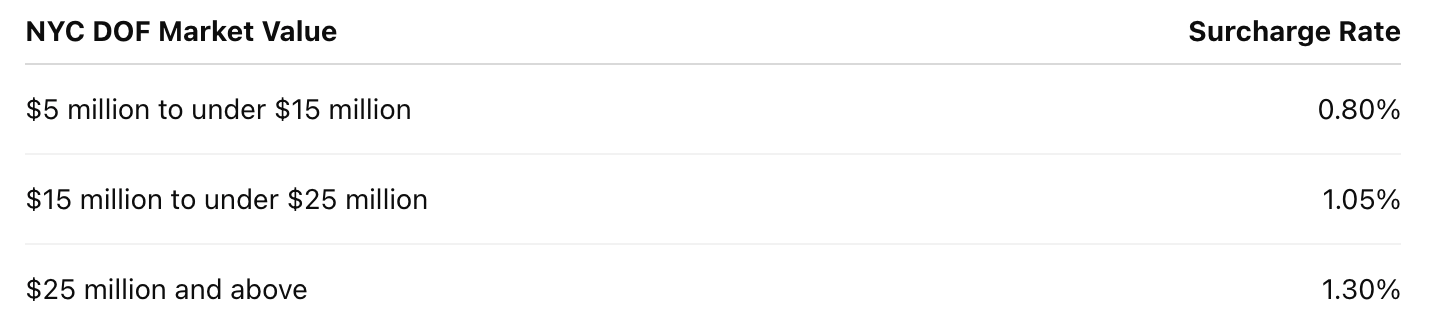
For the 2026–27 and 2027–28 tax years, the current surcharge rates generally are:
NYC DOF Market ValueSurcharge Rate$5 million to under $15 million0.80%$15 million to under $25 million1.05%$25 million and above1.30%
For example, a qualifying non-primary one- to three-family home with a Department of Finance market value of $10 million could potentially face a surcharge of approximately $80,000 per year.
Condominiums and Cooperative Apartments
For condos and co-ops, the initial surcharge structure is different:
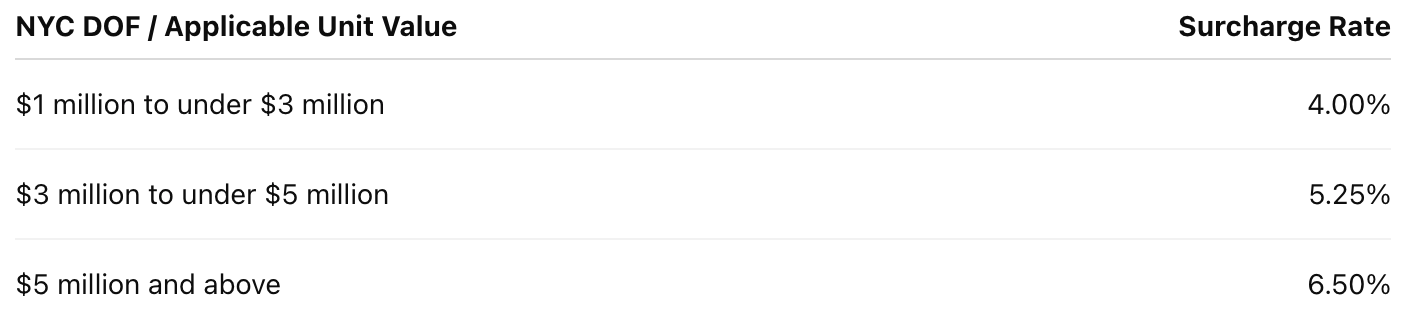
These percentages may initially appear surprisingly high. However, it is important to understand that NYC's Department of Finance valuation methodology for condos and co-ops differs substantially from the way buyers and brokers typically think about a property's open-market sale value.
As a result, you should not simply multiply the purchase price of a Manhattan condo or co-op by 4%, 5.25%, or 6.5% to estimate the tax.
The Department of Finance valuation is the critical number.
Why Purchase Price Isn't Enough to Determine the Tax
This is one of the most important aspects of the new NYC pied-à-terre tax for buyers to understand.
New York City uses its own property valuation methodology for tax purposes. Condominiums and cooperative apartments in particular are valued differently from one- to three-family homes.
That means two apartments with similar sale prices could potentially have different Department of Finance valuations and therefore different exposure to the surcharge.
Before purchasing a high-value NYC property as a second residence, buyers should therefore investigate the property's Department of Finance valuation and potential surcharge, rather than relying exclusively on the listing price.
How Could the Pied-à-Terre Tax Affect NYC Luxury Real Estate?
The new surcharge introduces another consideration for the luxury residential market, particularly in Manhattan neighborhoods where second-home ownership is common, including the West Village, Greenwich Village, SoHo, Tribeca, Chelsea and the Upper East Side.
For some buyers, the surcharge may simply become another component of the annual cost of owning a New York City residence.
For others—particularly buyers deciding between several properties—the potential annual tax could influence what type of property they purchase, how much they are willing to spend, or whether they choose a condo, co-op or townhouse.
Buyers
Luxury buyers should consider the surcharge when calculating the true annual carrying costs of a property.
That analysis should include:
NYC property taxes
Co-op maintenance or condo common charges
Homeowners insurance
Financing costs, if applicable
Potential assessments
The Non-Primary Residence Property Surcharge
For buyers purchasing a NYC pied-à-terre, understanding these costs before making an offer can help prevent an unexpected expense after closing.
Sellers
Sellers of properties likely to appeal to second-home buyers should also understand the surcharge.
A prospective buyer may incorporate the potential annual cost into their analysis of value and affordability. Being prepared to explain the property's Department of Finance valuation and provide relevant property tax information can therefore become increasingly important when marketing luxury real estate.
Investors
Investors should evaluate the rules carefully as well. Because certain properties occupied as a primary residence by a qualifying tenant may be exempt, the tax implications of an investment property can differ considerably from those of a residence maintained exclusively for an owner's occasional use.
Professional tax and legal advice is particularly important when evaluating these situations.
What If You Receive a Pied-à-Terre Tax Notice?
Receiving a notice from the NYC Department of Finance does not necessarily mean you owe the surcharge.
The Department of Finance has contacted owners of properties that may potentially be subject to the new tax. Owners who believe their property qualifies for an exemption can submit documentation to establish that the residence is exempt.
For the current filing period, the Department of Finance has extended the exemption application deadline to October 6, 2026.
Owners should pay close attention to the deadline stated by the Department of Finance and consult an appropriate tax or legal professional when necessary.
What Buyers Should Ask Before Purchasing a NYC Pied-à-Terre
If you're considering purchasing a second home in New York City, the pied-à-terre surcharge should now be part of your financial due diligence.
Before making an offer, consider determining:
What value has the NYC Department of Finance assigned to the property?
Is the property currently subject to the surcharge?
Would your intended use of the property qualify for an exemption?
What could the annual surcharge be based on the current valuation?
How does that amount affect the property's overall annual carrying costs?
Could your ownership structure affect eligibility for an exemption?
Your real estate attorney and tax advisor should ultimately determine how the law applies to your particular circumstances.
Final Thoughts: Buying a Pied-à-Terre in New York City
The new NYC Pied-à-Terre Tax adds another layer of financial planning for buyers and owners of high-value New York City real estate.
It does not mean that purchasing a second home in Manhattan no longer makes sense. But it does mean buyers should understand the property's Department of Finance valuation, potential exemptions and total annual carrying costs before making a purchase.
In a market where two properties with similar asking prices can have very different monthly and annual expenses, understanding the numbers can be just as important as negotiating the purchase price.
Thinking About Buying or Selling a Pied-à-Terre in NYC?
If you already own a secondary home in New York City and want to understand how the new surcharge could affect you, or if you're considering buying a pied-à-terre in Manhattan, selling a luxury NYC property, or evaluating your real estate options, reach out to me. I can help you review the property's Department of Finance valuation, comparable sales, pricing and potential carrying costs so you can make a more informed decision.
Primary Sources
• NYC Department of Finance – Non-Primary Residence Property Surcharge: https://www.nyc.gov/site/finance/property/non-primary-residence-surcharge.page
• NYC Mayor's Office – Announcement of the Non-Primary Residence Surcharge: https://www.nyc.gov/mayors-office/news/2026/04/mayor-mamdani--governor-hochul-announce-state-s-first-pied-a-ter
• NYC Department of Finance – FY2027 Property Assessment Roll: https://www.nyc.gov/site/finance/about/press/press-release-fy27-tentative-assessment-roll.page
This article is provided for general informational purposes only and should not be considered legal, accounting or tax advice. Tax laws and Department of Finance rules may change, and individual circumstances vary. Buyers and property owners should consult qualified legal and tax professionals regarding their specific situation.
Written by. Andy Feiwel | (E) andy.feiwel@compass.com , (M) 917.226.8429